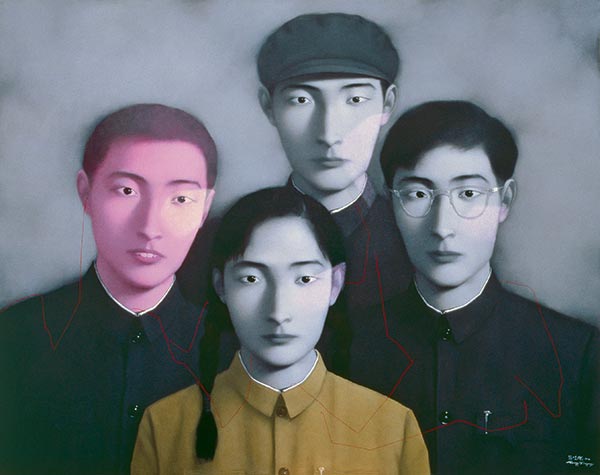
Zhang Xiaogang
Introduction
Zhang Xiaogang is a prominent figure in the contemporary Chinese art scene. Known for his distinctive style and thematic exploration of memory, identity, and the passage of time, Zhang's work has gained international recognition. Born in Kunming, Yunnan province, in 1958, Zhang became a celebrated artist through his evocative and sometimes surrealistic paintings. His most famous series, "Bloodlines: Big Family," has left an indelible mark on the art world, bridging Eastern and Western artistic traditions.
Early Life and Education
Zhang Xiaogang was born in Kunming, Southwest China's Yunnan province, in 1958. His early life in this culturally rich region greatly influenced his artistic development. In 1982, he graduated from the Sichuan Academy of Fine Arts, where he honed his skills and absorbed diverse influences. His education provided him with a foundation in both traditional Chinese and Western art forms, which he later integrated into his unique style. Influences from German expressionism and surrealism are evident in his early works, showcasing his ability to synthesize different artistic traditions into his own language.
Artistic Career
Zhang Xiaogang's artistic career took a significant turn in the early 1990s when he began the series "Bloodlines: Big Family." Inspired by a family photograph he saw at his parents' house, this series features monochromatic and stylized portraits of Chinese families. These works evoke the appearance of old family photos, prevalent in Chinese households during the latter half of the 20th century. The series gained international acclaim when it was exhibited at the Sao Paulo Biennial in 1994, marking Zhang's rise on the global stage. Over the years, his paintings have become coveted items in the art market, with pieces from the "Bloodlines" series fetching high prices at auctions. Despite the market success, Zhang emphasizes that his creative journey is forward-looking, continually evolving his themes and techniques.
Major Exhibitions
1989: Lost in the Dreams Gallery of the Sichuan Academy of Fine Arts, Chongqing, China
1997: Bloodline: The Big Family-1997 Gallery of the Central Academy of Fine Arts
1998: Bloodline: The Big Family-1998 Hanart Taipei Gallery, Taiwan
1999: Les Camarades Gallery De France, Paris
2000: Zhang Xiaogang 2000, Gallery of Max Potetch, New York
2003: "Amnesia and Memory", Gallery of France, Paris, France
2004: Umbilical Cord of History: Paintings by Zhang Xiaogang, Hong Kong Arts Center, Hong Kong
2005:"Zhang Xiaogang 2005", Max Protetch Gallery, New York, U.S.A.
2006: "Home –Zhang Xiaogang", Beijing Commune, Beijing, China "Zhang Xiaogang Exhibition", The Art Centre of Tokyo, Japan "Amnesia and Memory", Artside Gallery, Souel, Korea
2007: Sara Hildén Art Museum, Tampere, Finland
2008: Revision PaceWildenstein, New York "Chinese Painting: Zhang Xiaogang", Galerie Rudolfinum, Prague, Czech
2009: "Record", Pace Beijing Gallery, Beijing, China "Zhang Xiaogang: Shadows in the Soul", Queensland Art Gallery, Brisbane, Australia
2023: "Zhang Xiaogang: Mayflies," Long Museum West Bund, Shanghai, China
Zhang Xiaogang has presented his works in numerous prestigious exhibitions around the world. One of the highlights was his first solo exhibition in Shanghai, titled "Zhang Xiaogang: Mayflies," held at the Long Museum West Bund. This exhibition featured more than 80 artworks, including oil paintings on paper and canvas, installations, and sketches. The theme of "Mayflies" explores the transience and insignificance of human existence, a philosophical idea deeply rooted in Chinese literature.
Influence
Zhang Xiaogang's influence extends beyond his artistic creations, shaping contemporary Chinese art's discourse and market. His works, particularly the "Bloodlines" series, have become iconic, recognized for their emotional depth and cultural resonance. Zhang's ability to capture the collective memory and identity of Chinese society has resonated with audiences worldwide, establishing him as a pivotal figure in the global art scene. As a leading figure in the "Sichuan Army," a group of artists from the Sichuan Academy of Fine Arts, Zhang's contributions to art history are significant, ensuring his place as a cornerstone of contemporary Chinese artistic expression.








